Why Dismantling NCAR is a Huge Mistake

Yesterday, the White House rocked the scientific world by announcing that it would be dismantling and substantially defunding the National Center for Atmospheric Research (NCAR), beginning “immediately.”

This is a scientific catastrophe.

“I’m not going for hyperbole, but I firmly believe we’re talking about setting back science in this country by decades,” Antonio Busalacchi, president of NCAR’s parent body, the University Corporation for Atmospheric Research, said today at the annual meeting of the American Geophysical Union. “And not just science—we’re talking about [scientific] input that saves lives, [saves] property, advances economic development, and [enhances] national security,” he said.

NCAR is an organization most people have probably never heard of. But it is extremely well known in the earth sciences field, where it provides basic research fundamental to our understanding of such issues as coastal flooding, wildfires, 90-day weather forecasts, and hurricane forecasting.

It has even played a role in improving airline safety. “We’ve not had a casualty [in many years] from an aircraft crash due to wind shear or downbursts,” Busalacchi said. “That’s a result of a monitoring system, put in for severe, extreme weather” that was developed by NCAR.

Why is NCAR being dismantled? According to comments given to USA Today by Russ Vought, director of the White House Office of Management and Budget, it’s because of three main offenses: (a) it is a hub of “climate alarmism”; (b) it is engaged in excessively woke activities; and (c) it has done research on the impact of “weather conditions and changing climate” on wind energy.

All of these reasons are bogus.

“Climate alarmism” is activism. Organizations like NCAR are not activists or lobbyists. “We are physical scientists.” Busalacchi said. “We may inform policy, but we’re not political scientists. [Our job] is not to prescribe policy.”

Nor is the Center radically “woke.” In fact, the “woke” activities singled out by the Administration were small aspects of what the Center has done. One was the Rising Voices Center for Indigenous and Earth Sciences, designed to “make the sciences more welcoming, inclusive, and justice-centered” for indigenous peoples. NCAR dropped its funding for the project in January 2025, shortly after President Trump’s anti-DEI executive order was issued, Busalacchi said. “We were one of the very first [to comply with that order]. In less than 72 hours we were in complete compliance.” (It’s not clear whether the Center remains active under different funding.)

The other singled-out activity was an art exhibit focusing on humanity’s association with water. Why that is “woke” is not readily apparent. “Water is a natural resource,” Busalacchi said. “It should be apolitical.” And he noted, “no federal funding was received [for] that art exhibit.”

As for wind power? Yes, that’s a truly dangerous third rail in today’s Administration, but NCAR wasn’t building windmills, Busalacchi noted: it was helping to forecast power generation from them. By doing so, he said, it was saving money for Americans ratepayers by lowering their utility bills.

Another part of Vought’s order called for salvaging those portions of NCAR that the Administration does find useful, and splitting them into multiple smaller centers. That, too, is counterproductive. To begin with, Busalacchi noted, it will produce disorganization and inefficiency because the various parts of the center’s activities reinforce each other. “They go hand in hand,” he said.

Not only will splitting them into separate smaller centers impede the science, he said, but it will waste considerable amounts of money by requiring multiple new HR systems, IT systems, legal systems, communication systems, press offices, etc.

“It’s trite to say it, but the whole really is greater than the sum of the parts, ” Busalacchi said.

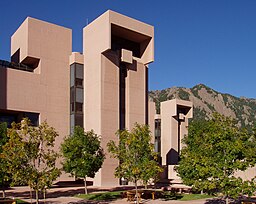
Photo by en:user:Daderot, CC BY-SA 3.0 http://creativecommons.org/licenses/by-sa/3.0/, via Wikimedia Commons
Super-spreaders, COVID-19, and the rural/urban divide

Nobody wants to be in a state with a lot of COVID-19 cases. Nobody except perhaps an epidemiologist trying to study how the disease spreads.

In a paper in today’s Proceedings of the National Academy of Sciences, a team from Emory University (in Atlanta) and the Georgia Department of Public Health, took advantage of the fact that their state ranks 6th in the U.S. in per capita cases to hone in on just how the disease spreads.

They looked at data from the five counties in the state with the most cases, looking for, among other things, superspreader events.

Continue reading Super-spreaders, COVID-19, and the rural/urban divide

Why a Mask IS a Political Statement…Just Not a Partisan One

Unless you’ve had the news turned off for the past week, you know that the Mask Wars are on, with a lot of people suggesting that wearing a mask marks you as a Democrat while not wearing one marks you as Republican.

And superficially, there’s something to that. We have a President who declines to wear a mask in public and who not only taunts Joe Biden for wearing one, but at a recent press conference shamed a reporter for being “politically correct” when the reporter refused to take off his mask at the President’s request.

Continue reading Why a Mask IS a Political Statement…Just Not a Partisan One

Covid-19 & the Emperor’s New Clothes

We all know the story of the emperor’s new clothes. In it, the emperor is hoodwinked by rogues who take his money and make him…nothing. “Nothing” that his advisors, fearful of offending him, declare to be the finest finery in the land.

Then, the emperor dons the non-existent robes…and a little child calls him out, exclaiming, “But the Emperor has nothing on at all!”

Except…The original fable, by Hans Christian Andersen, is a little more complex.

Continue reading Covid-19 & the Emperor’s New Clothes

How to Make COVID-19 Evolve to Become Less Dangerous

Donald Trump says that even without a vaccine, COVID-19 will eventually fade away. And amazingly, the science says he might be right…though not if we follow his plan for reopening the country.

The science in question is evolutionary virology.

It says is that under certain circumstances viruses will evolve into less virulent forms. In fact, this might even be what happened to the 1918 Spanish Flu…though not until after it killed tens of millions of people.

Let me explain.

In order to be an evolutionarily successful, virus can’t just infect one person, they have to jump from one person to another. They can do that by making us cough, giving us diarrhea that contaminates other people’s food or water, or giving us sores that shed virus particles onto anyone or anyone we touch.

I.e., they make us sick.

But if they make us too ill, too quickly, they don’t get much chance to spread because we either collapse into bed, away from other people, or make others leery enough of catching the disease that they take suitable precautions.

Continue reading How to Make COVID-19 Evolve to Become Less Dangerous

The Corruption of Critical Thinking

This post is not directly about politics or COVID-19. But it should be, which is why I’ve tagged it for both.

When I was teaching at California State University, Sacramento in the late 1980s, the Cal State system was trying to increase the focus on classes that emphasized critical thinking.

If there was an official definition, I never saw it, but my department made it clear that the environmental studies law-and-public-policy classes I taught were exactly what they wanted.

I ran these classes not as lectures, but as discussions based on assigned readings, and my biggest goal was to challenge the students to think about the readings’ implications, rather than just taking them at face value.

One of my favorite moments was a discussion in which one of the students flipped whatever I was saying at the time back on itself and pointed out something I’d overlooked. “That’s what you taught us to do,” he said, when he realized how well he’d hoisted me by my own petard.

I don’t remember what grade he got for the course, but for that day, he definitely got an A+.

Since then, however, I’ve found that critical thinking is all too often replaced by shorthand substitutes.

Continue reading The Corruption of Critical Thinking

Scylla, Charybdis & COVID-19

In Greek mythology, Scylla and Charybdis were monsters guarding opposite sides of the narrow strait between Italy and Sicily. Chart a course too close to one side, and Scylla grabs you. Try to steer clear of Scylla and you fall prey to Charybdis.

It’s hard to think of a better metaphor for the modern moment.

Except…in the Greek lore, the two monsters acted independently. Now, it’s more like each isn’t so much trying to snare you for itself as to drive you into the other’s clutches. And it’s something we seem to be doing our level best to assist.

Let me elaborate.

Continue reading Scylla, Charybdis & COVID-19